

7 Min Read
How growing organisations can introduce stronger governance, clearer ownership and better performance without building unnecessary bureaucracy
As organisations grow, informal ways of managing IT services often begin to show their limits.
Requests are handled through a mixture of email, messaging and personal knowledge. Responsibilities are understood by a small number of people but are not clearly documented. Reporting focuses on what is easy to count rather than what leaders genuinely need to know. Suppliers are reviewed inconsistently, and recurring issues remain unresolved because operational pressure always takes priority.
For a time, this can work. Small teams are often adaptable, experienced and close to the people they support. Problems are solved through relationships, judgement and effort.
But as demand increases, services become more complex and expectations rise, the same flexibility can become a source of risk. Decisions become harder to explain, work is prioritised inconsistently and service quality depends too heavily on individual knowledge.
The answer is not to recreate the structure of a multinational organisation.
It is to introduce the right level of governance, discipline and visibility for the organisation you are today—and the organisation you are becoming.
What does “enterprise-grade” actually mean?
Enterprise-grade service management is often associated with large teams, complex tooling, extensive documentation and formal governance structures.
That can make it appear unsuitable for smaller organisations.
But the real value of enterprise service management does not come from the volume of process or paperwork. It comes from a small number of important principles:
Services have clear ownership.
Responsibilities are understood.
Performance is visible.
Risks are actively managed.
Suppliers are held accountable.
Decisions are supported by evidence.
Improvements are prioritised and tracked.
Critical knowledge does not sit with one person.
These principles are relevant to organisations of every size.
The difference is how they are applied.
A larger organisation may need formal service boards, dedicated process owners and extensive assurance controls. An SME may achieve the same underlying objective through a short monthly service review, clear ownership of key processes and a focused set of meaningful measures.
The standard should remain high. The method should remain proportionate.
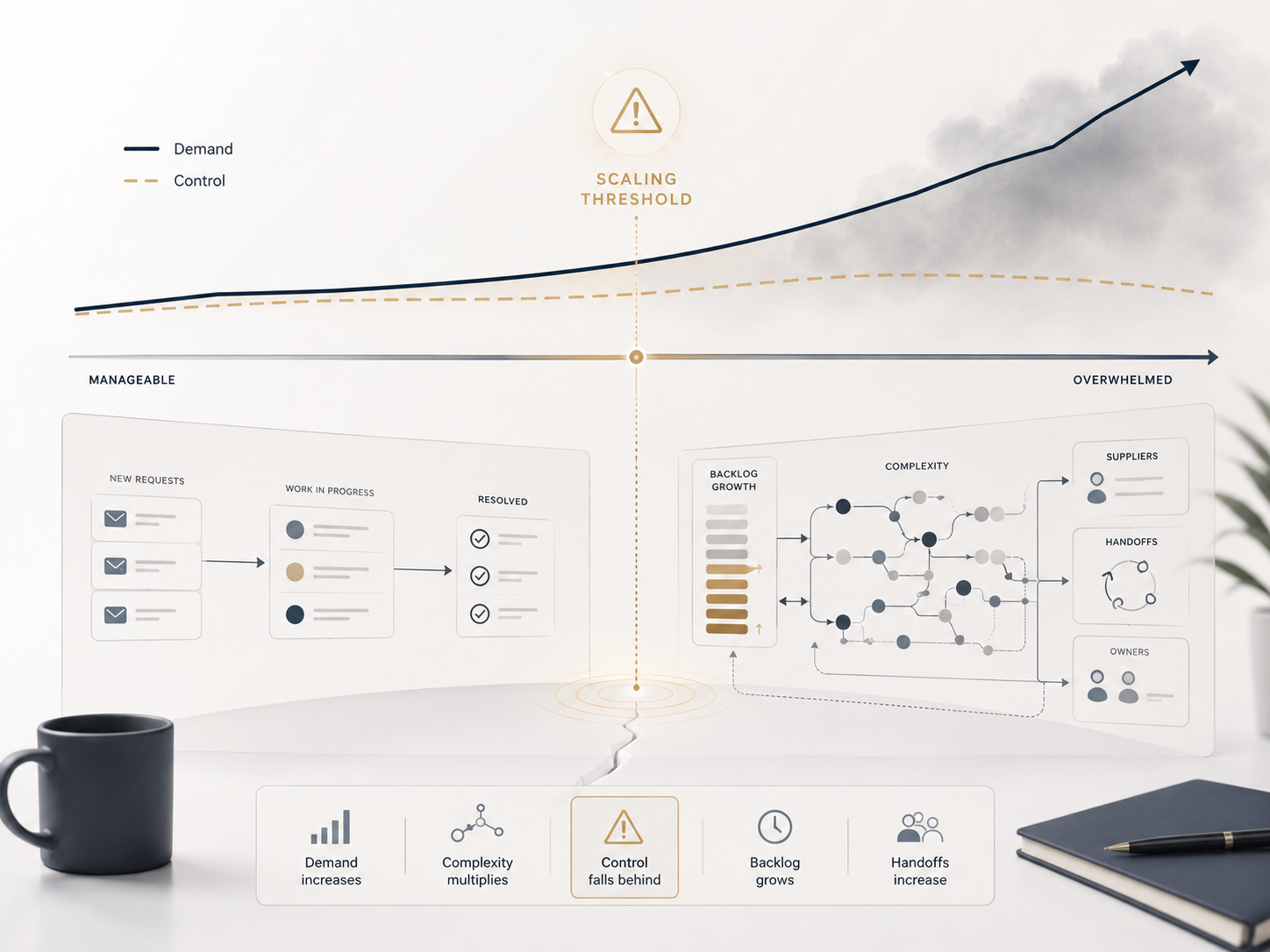
The point at which informal working stops scaling
Most organisations do not suddenly decide that their service-management approach is no longer sufficient. The warning signs usually appear gradually.
Common indicators include:
Performance is difficult to explain
Leaders receive ticket volumes and SLA percentages but still cannot confidently answer questions such as:
Why is demand increasing?
Which services are creating the most disruption?
How old is the backlog?
Where is performance being lost?
Are users receiving lasting resolutions?
Which supplier issues require escalation?
When reporting describes activity but does not support decisions, visibility is limited.
Ownership is unclear
Issues move between teams without a clear accountable owner. Process responsibilities exist informally, but nobody is responsible for maintaining them or ensuring they are followed.
When everyone is involved but nobody is accountable, improvement slows down.
The organisation depends on individual knowledge
Experienced staff know how services work, which suppliers to contact and how to resolve recurring issues. That knowledge may not be documented or consistently shared.
This creates operational risk and makes onboarding, succession and growth more difficult.
Recurring issues remain operational problems
Teams repeatedly resolve the same symptoms without addressing the underlying cause. Problem management becomes something that will be introduced “when there is time”, while demand continues to consume the available capacity.
Governance is reactive
Service reviews are held only when something goes wrong. Risks are discussed after they have already affected users, and suppliers are challenged without consistent evidence.
This is often the point at which service management needs to become more deliberate.
Where SMEs should focus first
The most effective approach is rarely to introduce every IT service-management process at once.
For many growing organisations, a small number of foundations will provide the greatest early value.
Clear service ownership
Every important service should have a recognised owner who understands:
What the service provides
Who depends on it
Which suppliers or teams support it
What risks affect it
How performance is measured
Which improvements are required
Service ownership does not need to become a separate full-time role. It does need to be explicit.
Without ownership, decisions are delayed, risks remain unresolved and responsibility becomes fragmented.
Meaningful service reporting
Good reporting should help leaders decide what to do.
A useful service view may include:
Demand and ticket trends
Backlog size and age
SLA performance
First-contact resolution
Reopened incidents
Major and recurring issues
Time since the last meaningful update
Customer satisfaction
Supplier performance
Risks and improvement actions
The purpose is not to create a larger dashboard. It is to create a clearer picture.
A small number of well-chosen measures is more valuable than a long report that does not change behaviour.
Consistent incident and request handling
Users should receive a predictable experience regardless of who is working.
That does not require a hundred-page procedure. It may require:
Clear categorisation
Agreed priorities
Defined escalation routes
Expectations for updates
Consistent resolution information
Simple closure and quality checks
Good process design supports judgement rather than replacing it.
Regular service governance
A short, structured service review can have significant value.
A proportionate monthly review might cover:
Performance against agreed measures
Aged or high-risk work
Recurring incidents
Supplier concerns
Service risks
Improvement actions
Decisions and ownership
The key is consistency. Governance should not exist only when performance deteriorates.
A practical improvement plan
Organisations often identify more improvement opportunities than they can realistically deliver.
A stronger approach is to prioritise actions based on:
Business impact
Operational risk
Customer impact
Effort
Dependencies
Available capacity
A 90-day improvement plan can create more momentum than a long transformation roadmap that feels disconnected from operational reality.
What SMEs should avoid copying from large enterprises
Larger organisations can provide useful examples, but their structures should not be adopted without challenge.
There are several common traps.
Introducing process for its own sake
A process should solve a problem, reduce risk or create consistency. If the organisation cannot explain why a control exists, it may be adding overhead without adding value.
Creating too many meetings
Governance should support decisions. It should not create layers of discussion before action can begin.
One well-run service review with the right people can be more effective than several overlapping forums.
Measuring everything
The availability of data does not make every measure useful.
Metrics should be linked to outcomes and behaviours. If a measure is not used to make a decision, challenge performance or guide improvement, it may not need to exist.
Designing processes that teams cannot sustain
A process that works only when people have spare time is unlikely to become established.
The best processes reflect actual working conditions, available capability and the maturity of the organisation.
Buying tooling before defining the problem
New platforms can support stronger service management, but they cannot compensate for unclear ownership, poor data, weak governance or inconsistent processes.
Tooling should enable an agreed operating model—not become a substitute for one.
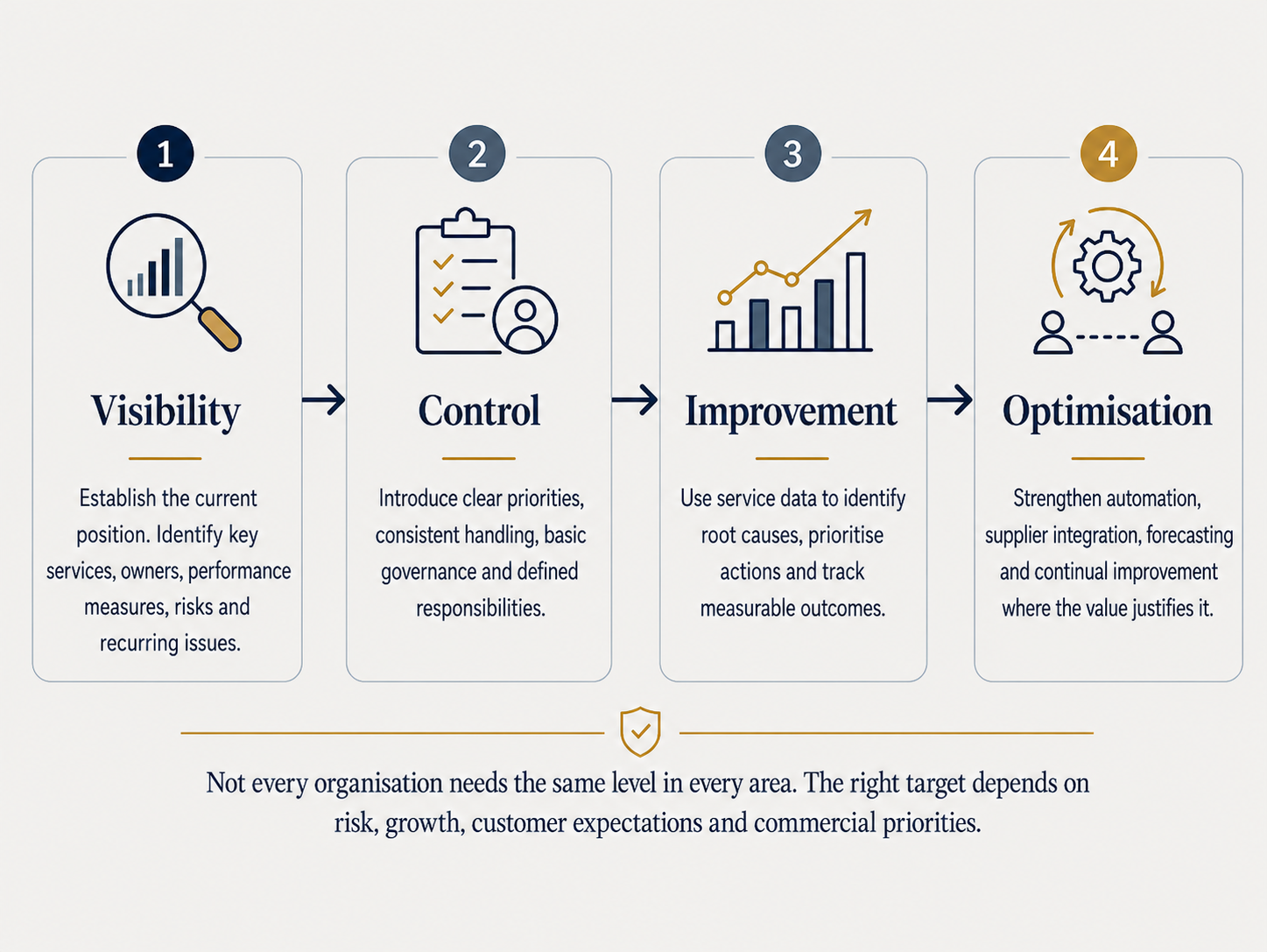
A proportionate maturity path
Service management does not need to move from informal to highly mature in one programme.
A practical progression might look like this:
Governance should enable delivery, not slow it down
The strongest service-management environments are not those with the most documentation.
They are those where people understand:
What matters
Who owns it
How performance is assessed
When escalation is required
What improvement looks like
Which decisions need to be made
Good governance creates confidence. It enables teams to move more quickly because expectations, responsibilities and boundaries are clearer.
Poor governance either creates bureaucracy or leaves teams operating without enough direction.
The goal is balance.
Enterprise discipline, adapted to your scale
SMEs should not have to choose between informal working and an expensive transformation programme.
There is a practical middle ground.
By focusing on clear ownership, meaningful reporting, proportionate controls and achievable improvement, growing organisations can build services that are more consistent, resilient and easier to manage.
Enterprise-grade does not have to mean enterprise-sized.
It means applying proven principles with enough discipline to create control, but enough judgement to keep them useful.
That is where effective service management begins.
About Metron Advisory
Metron Advisory helps SMEs strengthen IT service governance, improve operational performance and turn service insight into practical action.
Our approach draws on experience across defence, government contracts, housing and complex enterprise environments, adapting proven practices to the scale, maturity and priorities of each organisation.
Measure. Clarity. Impact.